
Most Amazon ad accounts we audit do not have a spending problem. They have a structure problem. Here is the campaign framework we use to keep spend focused on profit.
When we audit an Amazon advertising account, the same pattern appears again and again. There are dozens of campaigns, many of them targeting the same keywords, with budgets competing against each other. Nobody can say with confidence which campaign is responsible for profit and which is simply spending money.
Lowering bids across the board rarely fixes this. The real fix is structure: giving every campaign one clear job, so that each one can be judged against the right target.
Start with the numbers that matter
Before building anything, work out your break-even ACoS for each product. Take the selling price, subtract the cost of goods, Amazon fees and shipping, and express what is left as a percentage of the price. If a product makes a 30% margin before advertising, an ACoS above 30% loses money on every ad-driven sale.
That number becomes the reference point for every bid decision. Launch products may run above it for a period to build rank. Mature products should usually run comfortably below it.
Separate campaigns by purpose
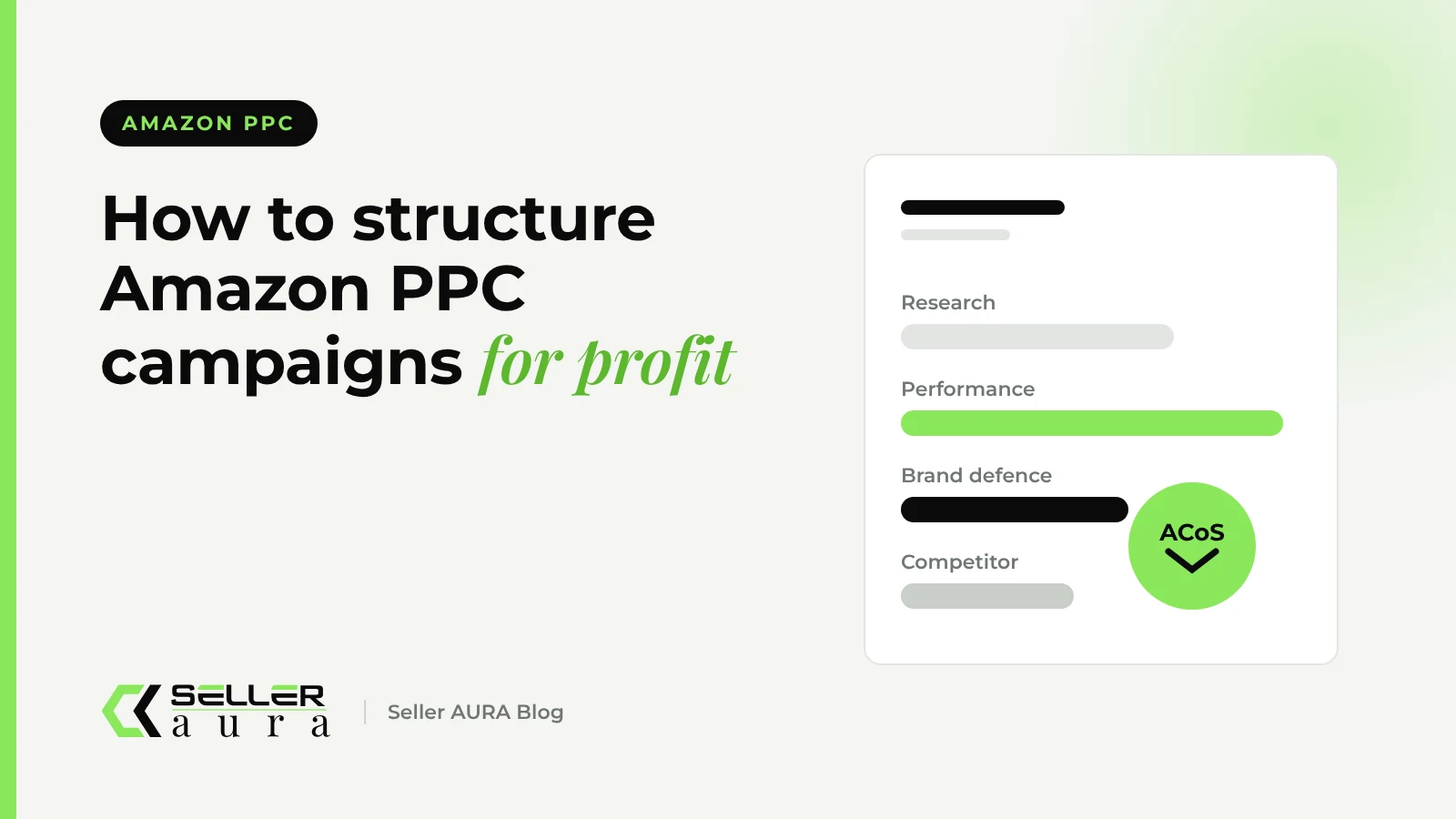
We split advertising into four groups, each with its own budget and target:
- Research campaigns. Automatic and broad match campaigns that discover new search terms. They are judged on what they find, not only on their ACoS.
- Performance campaigns. Exact match campaigns on proven, converting keywords, with bids set against each product's break-even ACoS.
- Brand defence campaigns. Campaigns on your own brand name and product names, so competitors cannot take cheap traffic from shoppers who already want you.
- Competitor and category campaigns. Product targeting on competitor ASINs and categories, run with tighter budgets and clear limits.
Keeping these apart means a strong brand campaign no longer hides a weak generic one, and a research campaign is not switched off simply because its ACoS looks high in isolation.
Move search terms through the structure every week
The structure only works if it is maintained. Each week, review the search term report. Terms that have converted at a profitable cost move from research campaigns into exact match performance campaigns, and are added as negative exact keywords in the campaign they came from, so the two do not compete.
Terms that have spent meaningfully without converting are added as negatives. Over a few months, this process steadily pushes spend towards what works and away from what does not.
Judge success by TACoS as well as ACoS
ACoS tells you how efficient your advertising is. TACoS, your ad spend as a share of total sales, tells you whether advertising is helping the whole business grow. A healthy account often sees TACoS fall over time as organic rank improves, even if ACoS stays level.
If ACoS looks excellent but total sales are flat, advertising may only be capturing sales you would have made anyway. If TACoS is falling while revenue grows, advertising is doing its job.
A simple checklist
- Know the break-even ACoS for every advertised product.
- Give every campaign one purpose and one target.
- Use negative keywords to stop campaigns competing with each other.
- Review search terms weekly and move winners into exact match.
- Report on TACoS and total sales, not only ACoS.
If your account has grown campaign by campaign without a clear plan, a restructure is often the fastest way to cut wasted spend without losing sales. Our free audit shows exactly where that waste sits in your account.